
Purple coneflower (Echinacea purpurea). Photo: Michael W., Wikimedia Commons, GFDL/CC BY-SA 3.0.
Understanding Ontario's soil variability
Before selecting wildflower species, it helps to understand what Ontario gardeners typically work with. Much of southern Ontario sits on a clay-heavy substrate deposited during post-glacial lake drainage. This clay holds moisture and nutrients well but drains slowly and compacts easily, which can inhibit root development in species adapted to drier prairie conditions.
The Niagara Escarpment and areas around Georgian Bay present well-drained sandy loam and thin topsoil over limestone — better suited to prairie and alvar species than to moisture-loving woodland wildflowers. In contrast, the Ottawa Valley tends toward heavier, more acidic soils suited to species native to mixed hardwood forests.
A simple jar test can determine your soil texture: fill a jar two-thirds with soil and water, shake, and let settle for 24 hours. Sand settles first, then silt, then clay. The proportions give a rough soil texture classification.
Species suited to clay-heavy soils
Several native Ontario wildflowers tolerate or thrive in clay soils, particularly when the site receives full to partial sun:
- Blue wild indigo (Baptisia australis) — deep-rooted and slow to establish, but extremely long-lived in clay once settled. Blooms in May–June with blue-purple flowers.
- New England aster (Symphyotrichum novae-angliae) — one of the most adaptable native asters; tolerates both wet clay and average moisture. Blooms in September–October, providing critical late-season nectar.
- Cardinal flower (Lobelia cardinalis) — suited to moist clay near water features or rain garden edges. Requires consistent moisture in its first season.
- Swamp milkweed (Asclepias incarnata) — a milkweed species native to Ontario's wetland margins, better suited to clay and moisture than the more commonly known butterfly weed.
Species for sandy and well-drained sites
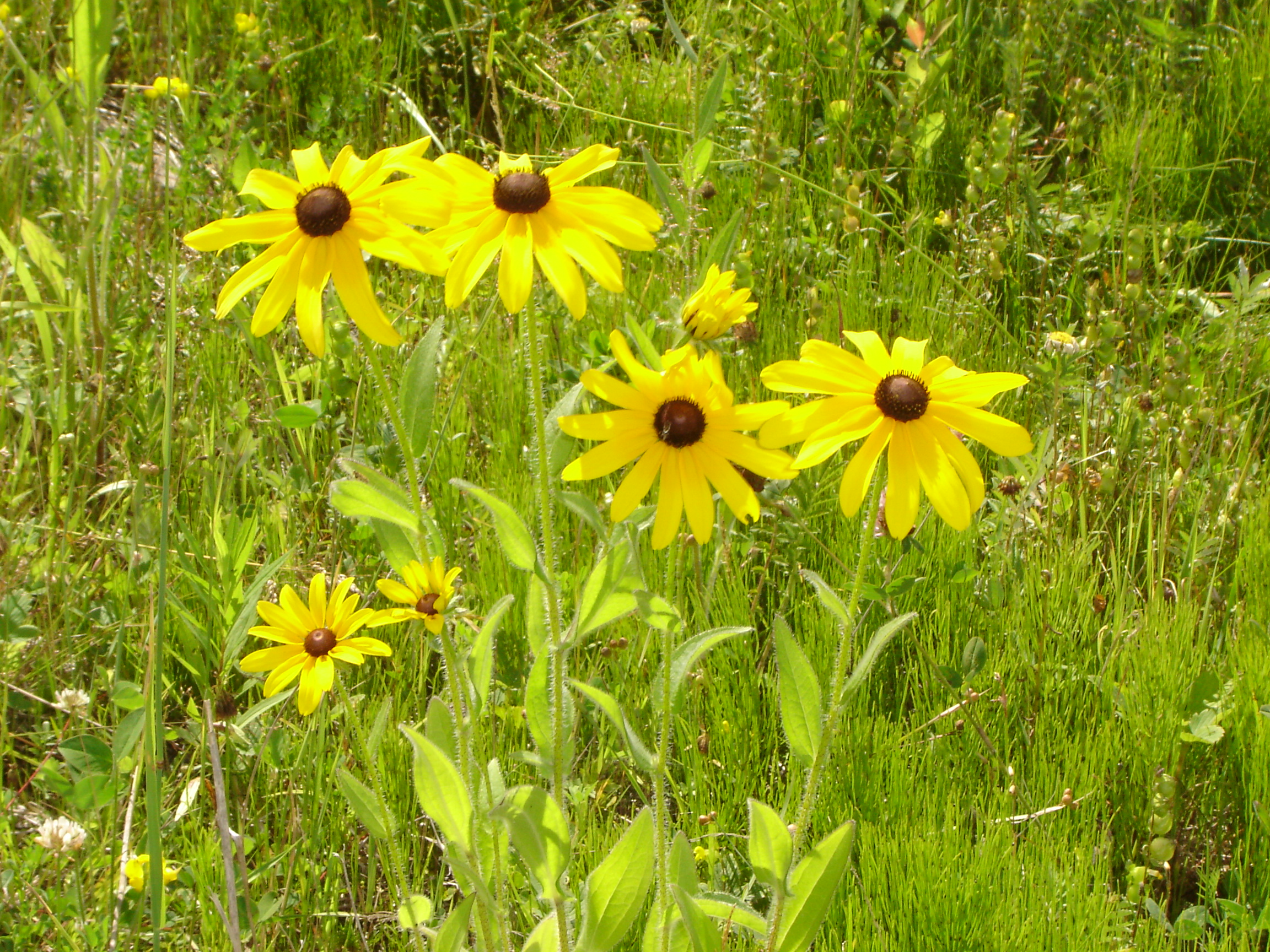
Black-eyed Susan (Rudbeckia hirta). Photo: Wikimedia Commons, CC BY-SA 3.0.
Sandy or gravelly soils dry quickly and warm early in spring. Native prairie and savannah species from Ontario's Carolinian zone are well-adapted to these conditions:
- Black-eyed Susan (Rudbeckia hirta) — highly adaptable; performs well in both sandy and average soils. Biennial in Ontario, self-seeding reliably where conditions allow.
- White beardtongue (Penstemon digitalis) — native to open woods and savannahs. Prefers well-drained soil and tolerates drought once established.
- Wild bergamot (Monarda fistulosa) — drought-tolerant once established. Native to Ontario's open meadows and roadsides; tolerates poor, dry soils better than many other natives.
- Purple coneflower (Echinacea purpurea) — among the most widely grown Ontario natives; performs best in well-drained loam but tolerates clay and sand with good drainage.
Woodland edge species
Areas with dappled shade — under deciduous trees, along fence lines, or at the north side of structures — support a different plant community than open meadows. Ontario's woodland wildflowers are adapted to low-light conditions and rich, leaf-mould soils:
- Wild ginger (Asarum canadense) — a low-growing ground cover native to Ontario's rich deciduous forests. Spreads slowly by rhizome and forms dense colonies that suppress weeds.
- Bloodroot (Sanguinaria canadensis) — one of the earliest spring bloomers in Ontario. White flowers appear before the leaves fully open. Requires rich, moist, well-drained soil and partial to full shade.
- Jacob's ladder (Polemonium reptans) — blooms in May–June in shaded woodland edges. Tolerates garden conditions better than many native woodland species.
Establishment: the critical first two years
Most native wildflowers focus energy on root development in their first growing season. Above-ground growth is often minimal. This is normal — not a sign of failure. By the end of the second season, most species will have established enough root depth to begin growing vigorously.
Key practices during establishment:
- Water weekly during the first growing season, particularly during dry spells in July and August
- Remove aggressive annual weeds before they set seed, but leave perennial native volunteers
- Avoid fertilizing — Ontario's native wildflowers evolved in nutrient-poor conditions and high fertility encourages leafy growth over flowering and root development
- Do not mulch directly against the crowns of wildflowers; a 5–8 cm layer of wood chip mulch between plants is acceptable
Timing seed sowing vs. transplanting
Seed sowing in fall (October to early December) allows native seeds to undergo natural cold stratification over winter, improving germination rates the following spring. This mimics natural seed dispersal cycles. Spring sowing requires artificial cold stratification — typically 60–90 days in moist paper towel inside a refrigerator — for many Ontario native species.
Transplanting potted nursery stock is generally more reliable for beginners. Spring transplanting (after last frost, typically mid-May in southern Ontario) gives the full growing season for root establishment before winter.
Sourcing plants
Ontario's native plant nurseries and conservation authority plant sales are the most reliable sources for locally-sourced native species. Locally-sourced (also called "local ecotype") plants are adapted to Ontario's specific climate patterns and will generally establish more successfully than cultivated varieties or plants sourced from US nurseries.
The Evergreen Native Plant Database maintains a searchable list of nurseries carrying native plants across Canada. Conservation Ontario coordinates periodic native plant sales through member conservation authorities each spring.

